To: Detroit/Seattle
Workers' Voice mailing list
October 20, 2020
Re: "Planet of the Humans" vs the environmental movement
Michael Moore released Planet of the Humans on April 21, the eve of the 50th anniversary of the first Earth Day. The director and narrator, Jeff Gibbs, and the producer, Ozzie Zehner, are both touted as being long-time environmentalists. (1) Some 10 million people have now opened the movie on youtube. (2)
Given this, one might have expected this Earth Day movie to aim its
guns against the continued burning of fossil fuels that is rapidly
heating the planet; one might have expected it to give real
encouragement to environmental activists and the broader masses who are
everywhere fighting to save the environment. But no, the filmmakers
leave us pondering such gloomy and passivity-inducing questions as
maybe industrial civilization itself is the problem, and maybe human
overpopulation is the problem. And to lead us into this dead end they
take aim at one of the solutions to the planetary crisis, renewable
energy.
Thus, it's no wonder why the right-wing and climate-denialist Breitbart News has said that "Moore has backed the most powerful, brutally honest and important documentary of his career.” (3) It's why the coal and Koch-backed Heartland Institute has released an hour-long podcast praising it. (4) It's why the fossil fuel industry-funded Competitive Enterprise Institute has urged people to “Hurry, see Planet of the Humans before it’s banned." (5)
But the the main thing about the film is that it's an attempt to
prove that there is nothing better than the fossil fuels. Thus, instead
of showing the need for better planning, and the need for continual
improvements in alternate power, director Gibbs hides that this process
of improvement is taking place, and should be spurred on. He surrenders
to the fossil fuel industry and says people will just have to die off.
He travels to Lansing, Michigan for the roll-out of the new Chevy Volt. There, he's told that 95% of the electricity used for charging the battery is generated with coal. (7) Horrible! But Gibbs doesn't tell us of the many studies that show electric cars are cleaner than gas or diesel powered cars despite the fact that the electrical grids used to recharge batteries are still predominantly supplied by fossil fuels. For example, after the Union of Concerned Scientists did a two-year review of the climate emissions from a vehicle's production, operation and disposal, it found that electric cars generate half the emissions of the average comparable gasoline car, even when pollution from battery manufacturing is accounted for. (8)
While in Lansing, Gibbs also visits a large solar power site. There he's told by a member of the city’s Board of Water and Light that the farm can only power ten homes in a year, and that the solar modules have an efficiency of just under 8 percent. But Gibbs doesn't tell us that this interview took place in December, 2010, and that the array was built in 2008! This is important because if he interviewed someone today he would be told that the efficiency of run-of-the-mill solar panels is around 16-18 percent, and that it has been rising. (9) Is that honest?
He takes us to a wooded mountain where a dozen wind turbines are to be built. A chosen interviewee likens what is happening to mountaintop removal, and Gibbs immediately takes up this exaggeration. But there's no mention of the fact that wind turbines are often sited on already-disturbed land as well as offshore.
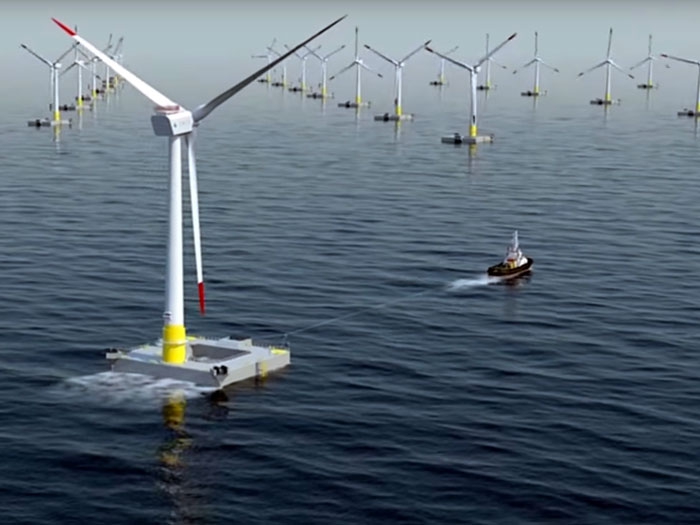
We're later shown a 482-foot wind tower that takes 800 yards of concrete for its base. But there's no mention of the fact that despite this, wind turbines have a carbon footprint over 11 times smaller than that of coal with carbon capture technology (10), or that their "carbon payback" period is from seven to nine months (11). Other studies conclude that the payback period is from one to three years, which is still short. Nor is there mention of the fact that wind turbines come in various sizes and shapes, e.g., small wind turbines that home owners and farmers mount on their buildings, or medium-sized turbines that are beginning to be used for floating offshore installations. (12) Nor is it mentioned that except for the rotors and base, wind turbines are recyclable, as well as having some parts that are directly transferable to new turbines.
Gibbs also as much as tells us that we shouldn't pay attention to
the claims that Germany gets 40, 50 or 60% of its electricity from
renewables because the main "renewable" they use is biomass. But this
is false. Although Germany does use too much biomass, under mass
pressure (13), it now gets about 36% of its electricity from the wind and sun. (14)
So we're shown a film clip of someone saying "Some solar panels are built to last only 10 years." Oh. Then why are today's solar panels often guaranteed to last 25 or 30 years?
Gibbs takes us to California's giant Ivanpah "central tower" or
"heliostat" solar power plant, where he examines some of its real or
imagined problems. For example, the Ivanpah facility is a green house
gas emitter because natural gas is used to start it in the morning. But
we're not told how those emissions compare to those of a gas, oil or
coal plant generating the same amount of electricity. Moreover, Gibbs
doesn't tell us that there are few such central tower solar plants in
the world, nor that their global generation of electricity is minuscule
when compared to that of photovoltaics (solar panels), nor that they
seem to be on the way out. During the course of their tour, Ozzie
Zehner snickers that glass is not a renewable. Brilliant. But glass is
recyclable, as are, for most part, solar panels. (15)
Zehner also tells one of the tall tales of the movie: “One of the most
dangerous things right now is the illusion that alternative
technologies like solar and wind are somehow different from fossil
fuels. You use more fossil fuels to do this than you’re getting benefit
from it. You would have been better off just burning fossil fuels in
the first place, instead of playing pretend.”
We're next taken to California's Daggett solar facility. Zehner
tells us they build, tear down and build again there, and that much is
true. We're not told, however, that the first two facilities torn down
were experimental. Nor are we told when Gibbs and Zehner view a leveled
desert area, and Gibbs declares, “It suddenly dawned on me what we were
looking at: a solar dead zone,” that this was mid-way through
replacement of an obsolete solar facility with a more efficient one.
Now despite the fact that central tower and "solar energy generating systems" (the type now used at Daggett) generate a tiny amount of electricity in contrast to solar panels, Gibbs and Zehner probably spend so much time on them because they see them as a soft target. Attacking solar panels (photovoltaics), however, is not so easy. Everyone knows that they're installed on rooftops (including of super stores and warehouses) and in fields, where, when properly spaced, crops can be grown between them. (There have also been successful experiments in growing vegetable crops beneath them.) They're also beginning to be installed at airports and over parking lots. China has floated solar panels over a lake caused by a collapsed coal mine, while the U.S. has about 20 floating solar installations. And India has installed panels over miles of canals, with the shade giving the added benefit of decreasing evaporation of the much needed water below.
He interviews numerous people who say you can't generate solar or
wind power unless the sun is shining or the wind is blowing. He also
interviews people who point out some of the problems of battery
storage. And while intermittency is indeed a problem, it is solvable
with present technology.
For example, when California has power shortages, the Bonneville Power
Administration (BPA) has long sent power over transmission lines from
Washington to the Los Angeles power grid, and today it can also send
power as far away as Nevada and Wyoming. (16)
Naturally, the BPA can only do this because it has extra electricity generated from the Columbia River power dams, but the same principle applies elsewhere. For example, the Great Plains and northern Rockies are ideal for wind farms because of their high average wind speeds. So there, with enough wind turbines and added transmission lines, power can be sent from areas where the wind is blowing to areas where it has stopped blowing, and it rarely stops blowing in a number of places. What's more, there is nothing wrong with using natural gas power plants as backups or to maintain a base load during the transition to renewables. In fact, it's necessary.
Meanwhile, in New Mexico a solar farm is being built that has 650 MW of solar generation capacity and 300 MW/1,200 MWh of accompanying energy storage, which is considerable. Besides that, the idea has always been that solar energy needs to be supplemented with wind energy, and eastern New Mexico has lots of wind.
Jeff Gibbs and Ozzie Zehner began attacking renewables more than a
decade ago, and this has contributed to a real impasse and retreat for
them. Gibbs says we environmentalists have to take control of our
movement from the present leadership, but to do what? Join him in
contemplating such misleading and backward questions as “Is it possible
for machines made by industrial civilization to save us from industrial
civilization?"
Well, imagine feeding, clothing and sheltering the human population
without industry. Imagine dealing with the needs of hundreds of
millions of climate refugees without industry. Imagine erecting
seawalls and moving cities without industry. No, the present issue is
to bring mass pressure on industry to act in ways that least destroy
the ecosystem.
Gibbs also devotes several minutes of the movie to contemplating "the underlying problem:" human population. One supposed scientist tells him that “We have to have our ability to consume reigned in. Without some major die-off of the human population there is no turning back.” Well, if nothing is better than fossil fuels, how big a die-off are they proposing as necessary? 50%? 90%?
But returning to reality, the very industrialization that Gibbs throws stones at brings declining population growth rates, and sometimes outright declining populations (15 countries, with Japan the most populous). For example, India's population growth rate peaked in 1974, and is expected to be down to 2.1 children per woman by next year. Moreover, the areas of India with the most industry have seen the largest declines in rates of population growth. (17)
Planet of the Humans ends with tragic footage of orangutans facing death due to the native forest being destroyed in order to plant a palm oil plantation in Borneo. But why has there been such a rapid expansion of palm oil plantations this century? Well, under the UN's so-called solution to global warming, "cap and trade," the big polluters in the richer countries are given "carbon offsets" for financing them. The result has been fiascoes like palm oil plantation offsets, among others. (18)
In fact, "cap and trade" and the carbon tax (another favorite of the global establishment) have miserably failed for two long decades because they're market measures. Down with them! Environmentalists should instead fight for planning and regulation of production (including agriculture) and transportation. Along with this, environmentalists should fight for this planning to have the interests of the masses of people and their environment at its center (as much as that's possible under capitalism). And for the latter to occur is going to require fight after fight for open meetings that allow the masses of people to have their say in defense of their interests.
It's going to take a more powerful movement than the world has yet
seen in order force this to happen. And to speed the process is going
to require not only drawing more members of the working class majority
into the environmental movement, but also require building a distinctly
working-class environmental trend in the overall movement. Unlike the
capitalists, it's in the material interest of the workers to fight
against environmental racism and the national-chauvinist dumping of
garbage on the poorer countries of Africa and elsewhere. As
more-organized workers increasingly take up battles against these
outrages they'll be giving the environmental movement increasing moral
authority.
So the issue isn't that environmentalism is hopeless, but that it is
establishment environmentalism, which is tied to neoliberalism and has
compromised itself with corporate funding, that has led to one fiasco
after another. Many active environmentalists have fought against
aspects of establishment environmentalism. Meanwhile, the Communist
Voice Organization has written for years about the different fiascos,
like biomass, palm oil, cap and trade and others of the corporate
environmentalists. (19)
The point isn't to give up on environmentalism, but to realize the need
to go separately from establishment environmentalism, fight the
corporate polluters, and support effective environmentalism.
(1) But it would be more accurate to say that Gibbs and Zehner have been abandoning militant and forward looking environmentalism for a long time. For example, Gibbs was already espousing deep skepticism of wind and solar energy in March, 2010. Then, in 2012, Ozzie Zehner came out with his Green Illusions - The Dirty Secrets of Clean Energy and the Future of Environmentalism. His present internet description of the book includes says it "Shows why future environmentalists will resist hybrid and electric cars, Reveals the five unseen harms of solar cells, Shows why contraception alone won’t solve overpopulation, Explains why engineers can’t solve wind power’s biggest obstacle and what they’ll really need." See https://ozziezehner.com/book/. The first two chapters are titled "Solar cells and other Fairy Tales", and "Wind Power’s Flurry of Limitations".
(2) https://www.youtube.com/watch?v=Zk11vI-7czE.
(5) https://cei.org/blog/hurry-see-planet-humans-it%E2%80%99s-banned.
(6) While electric cars are certainly more environmentally friendly than gas or diesel ones, the goal of environmentalists has never been to just replace all of the gas or diesel burning cars jamming the roads with electric ones. In fact, they have consistently stressed the need for clean mass transit, something that is common in Europe, and which is very doable in the U.S. For example, Seattle had a fleet of hundreds of electric trolleys from 1940 through the 1970s. Those buses accelerated quickly. They were fast. They climbed hills better than diesel buses. Many of those scrapped in the 1980s had run for 40 years. And manufacturing them left a smaller carbon footprint than manufacturing the large articulated buses in use today. Additionally, electric locomotives have long been used in Europe and elsewhere, and China's famous bullet trains are electric.
(7) Of course, if Gibbs had gone to another city the mix on the grid would have likely been something other than 95% coal. For example, in Seattle around 88% of the electricity comes from hydroelectric generation and 4% from wind.
(8) https://www.ucsusa.org/sites/default/files/2020-05/evs-cleaner-than-gasoline.pdf.
(9) https://singularityhub.com/2019/08/09/the-age-of-solar-energy-abundance-is-well-on-its-way/.
(10) https://www.factcheck.org/2018/03/wind-energys-carbon-footprint/.
(12) https://www.marinelog.com/wp-content/uploads/2017/09/c7fcb0c5af6886110dd6ab99da091326.jpg.
(13) https://www.youtube.com/watch?v=OWIo-oZoFZo.
(14) https://www.cleanenergywire.org/factsheets/germanys-energy-consumption-and-power-mix-charts.
(15) https://www.albioma.com/en/magazine/how-are-solar-panels-recycled/ But while the main bulk of a solar panel can easily be recycled, there remain problems in separating out certain toxic chemicals from a small part of the panel. This shows the necessity to put pressure on the manufacturers and recycling companies, who always want to do things the cheap way, to come up with a solution. Environmentalists can also demand that governments finance research and development aimed at solving this problem..
(16) https://en.wikipedia.org/wiki/Bonneville_Power_Administration.
(17) https://www.macrotrends.net/countries/IND/india/population-growth-rate
and https://www.populationconnection.org/planet-of-the-humans/.
(18) See, for example, the third section of the article at http://communistvoice.org/41cAlGore.html.
(19) See the many articles at http://communistvoice.org/00SavingThePlanet.html. <>
Back to main
page,
how to order CV,
write us!