To: Detroit/Seattle
Workers' Voice mailing list
March 29, 2022
by Pete Brown, Detroit Workers’ Voice, and Frank Arango, Seattle Workers’ Voice
The majority of the world's people today live under authoritarian governments, with the trend of recent years being toward more authoritarianism. Last year there were military coup d'etats in five countries, including Sudan and Myanmar (also called Burma). But inspiring democratic movements of millions have risen against the new military dictatorships in the latter two countries, and all oppressed humanity has a stake in their success. Following is an update on the struggle in Myanmar.
After suffering a crushing defeat by Ms. Aung San Suu Kyi's
National League for Democracy (NLD) in the November 2020 election, the
Myanmar military, called the Tatmadaw, seized power on February 1,
2021. Senior General Min Aung Hlaing became head of state.
But despite the generals having 406,000 active-duty soldiers, thousands
of police and spies and control of the mass media, they are still
unable to suppress the peoples' democratic rebellion that immediately
erupted against the coup. Indeed, while aspects of this rebellion have
temporarily been beaten down, 14 months later others are growing. Suu
Kyi is still under house arrest, and many officials from her party are
constantly being arrested and jailed, charged with corruption. (1)
Several have even been executed for “treason.” But many of them
continue to secretly support the struggle against the military,
including the armed struggle.
Last spring millions of people participated in protests everywhere
in the country. A civil disobedience movement developed in which
civil servants and other government employees refused to go to
work. Garment workers, rail workers, health care workers, port
workers, teachers, miners, and other contingents of the working class
waged many strikes, with young women garment workers prominent in the
strike movement and urban protests. (2) This powerful movement, along
with international sanctions and a domestic boycott of products from
Tatmadaw-owned businesses, paralyzed Myanmar’s economy. The World Bank
estimates the economy has shrunk by 30 percent since the coup and the
COVID-19 pandemic. Today thousands of civil servants and other
striking workers have had to return to work in order to eat. But
for large numbers of others there are no jobs to return to. For
example, the garment industry employed some 600,000 workers before the
economic collapse, most of them women. But in June the
International Labour Organization reported that 250,000 garment workers
had been laid off, and more than half of the rest were working at
reduced hours.
Faced with the spring uprising, the Tatmadaw resorted to brutal repression of the movement. It killed at least 114 civilians on March 27 of last year, and it has now murdered over 1,550 people, detained some 9,000 and tortured unknown numbers. This has made organizing large demonstrations in the cities impossible. Nevertheless, urban activists continue to keep the movement alive there by organizing "flash mobs" where scores or a few hundred people secretly agree to meet at a location, unfurl their banners and signs, march and shout slogans, then melt into the neighborhoods when the authorities begin to arrive. Along with this, underground organizing continues.
But Myanmar has a population of 55 million people, with two thirds of them living in rural areas -- mountains and plains, jungles and rice paddies. It's impossible for the Tatmadaw and police to be everywhere at once. Thus, the daily-occurring protest marches and other anti-junta activities in the rural areas often go unmolested. The many thousands of women who've returned to their home villages due to layoffs in the garment industry are playing a significant role in protests there. And now, the Tatmadaw must deal with a shadow National Unity Government (NUG) and a people's war aimed at overthrowing it.
Formed in April of last year, this government-in-waiting consists of
elected parliamentarians of the overthrown government as well as
representatives of various mass movements. Half of its cabinet
members belong to oppressed ethnic minorities, who comprise about one
third of the country's population. The NUG supports and helps
organize both the armed and peaceful sides of struggle against the
Tatmadaw. It has released a new interim constitution based on
federalist democratic principles, including granting autonomy to ethnic
minority regions as well as citizenship for the Rohingya people.
This is important for the struggle, since Aung San Suu Kyi and the NLD
had previously covered up the military’s genocidal campaign against the
Rohingya that began in 2016 and resulted in the flight of over a
million Rohingya out of the country. In late 2019, Aung San Suu
Kyi even traveled to the Hague to defend her government against charges
of genocide, war crimes and crimes against humanity. But now the
NUG promises to repeal the 1982 Citizenship Law which excluded the
Rohingyas from citizenship. It says that whatever future law replaces
the 1982 law “must base citizenship on birth in Myanmar or birth
anywhere as a child of Myanmar citizens.” It continues: “We will
actively seek justice and accountability for all crimes committed by
the military against the Rohingyas and all other people of Myanmar
throughout our history,” and says the NUG is committed to a “voluntary,
safe, and dignified repatriation” of Rohingya refugees. If the NUG wins
power, living up to these promises will be a test of how democratic it
is.
By late March of last year activists were already manufacturing weapons and organizing armed actions to defend protests from the military and police. Then, in early May, the NUG announced it was setting up a Peoples Defense Force, which is a system of cooperating military units operating all over the country. These forces get training from defected Tatmadaw soldiers and from some of the longstanding ethnic armed organizations, as well as learn fighting through fighting. Since they have more volunteers than they can supply weapons for, they continue to depend on underground-manufactured rifles, shotguns and IEDs, captured weapons, and weapons they buy. The latter is facilitated by monetary contributions from the 1.7 million Myanmar nationals working in Thailand and the half-million working in Malaysia. Recently they have used small, off-the-shelf drones to drop munitions.
The main tactic of the PDFs has been ambushing soldiers and
police. They have also assassinated junta collaborators and
government officials, and at times united with ethnic rebels for major
raids on Tatmadaw and police outposts. Last December over 1,000 attacks
against junta forces were reported across the country. More than 15,000
soldiers and police have deserted since last year’s coup, and more than
2,000 of those have joined the resistance movement.
The PDF is not one centralized, coordinated army. Still, they have
inflicted thousands of casualties on regime forces, including about
2,000 killed. Some of them work in conjunction with ethnic/national
groups that have their own armed forces and have been fighting against
the central government for decades, demanding greater autonomy and
rights. (3) One such armed group claims it killed 160 of the regime’s
soldiers in just the first two weeks of January. (4) In one recent
action, PDF forces shut down a large nickel-processing plant owned by a
Chinese consortium. (5) PDF spokespeople say they had demanded that
China withdraw its financial support for the regime. But the consortium
continued to pay royalties and taxes to the military government. So,
the PDF blew up pylons that delivered electricity to the plant.
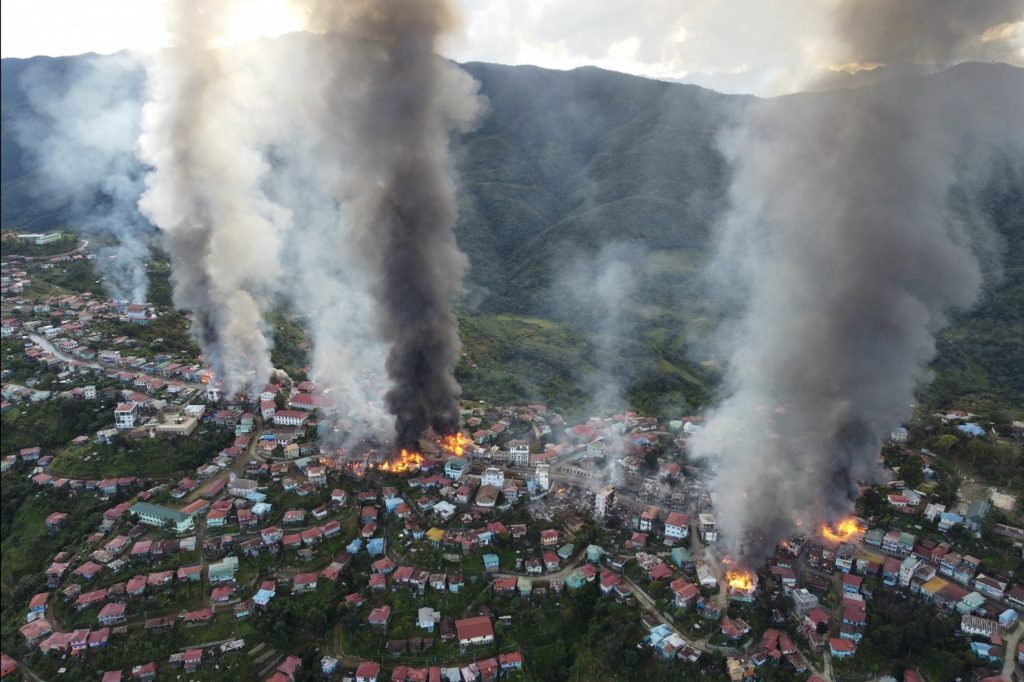
The Tatmadaw is turning to ever more brutal attacks on civilians as it becomes weaker. Areas that are suspected of harboring rebel forces are bombed with aircraft and drones. (6) This forces people to flee their home villages and become refugees. Today there are hundreds of thousands of them in refugee camps in neighboring countries. Occasionally they try to return but are then subject to raids by the Burmese military. And if they flee, their homes and possessions are ransacked by the military, which organizes gangs to steal everything of value from the refugees. (7) In January, the military launched an offensive in Kayah state in southeast Myanmar during which they set up blockades and checkpoints, attacked villages and assaulted the capital, Loikaw, with airstrikes and artillery. In the ensuing chaos, Loikaw was depopulated, and half the population of Kayah has become displaced, running to other states or hiding in the jungle. (8) Throughout the country, about half a million have been displaced since last summer, and international NGOs as well as local aid groups have found it increasingly difficult to provide food and shelter, much less medical aid, to people fleeing the military. (9) In latest news, it appears the regime is gearing up for a new offensive in western Myanmar, as it has sent a convoy of troops and armored vehicles there.
While arresting former leaders of NLD and charging them with corruption, the military leaders have shown themselves to be increasingly corrupt. They profiteer from brokering arms purchases from other countries, and their latest deal involved brokering the sale of Telenor, a telecom company. Telenor’s Norwegian owners refused the regime’s demands to help them monitor their clients’ communications, so they were forced to sell the company to new owners, a Lebanese investment firm tied to that country’s prime minister and a Burmese firm tied to the military. A major investor in the Burmese firm is a daughter of the military’s top general. So now the military will have access to Telenor’s 18 million clients and all their telecommunications – while they make money off the deal! (10)
Declarations of support for Ukraine came from across Myanmar as Russia began its invasion. Activists organized flash-mob protests in Yangon, the national capital, as well as in other cities. The exiled NUG issued a statement condemning the Russian invasion and noted that Russia is a major arms supplier for the Burmese military. Meanwhile, the regime itself declared its support for Russia’s actions. (11) Bombing apartment buildings and theaters, massacring children in schools and hospitals is just fine with the Burmese military leaders. That’s just the sort of “making an example” they’re used to. Their support for the Russian invasion underscores their fascist nature and shows the importance for the world’s working people to support the ongoing struggle against the Tatmadaw.
(1) “Myanmar junta jails Rakhine state ministers on corruption charges.” The Irrawaddy, 19 January 2022.
(2) Joseph Green, “Myanmar rises against military rule.”, March 27, 2021.
(3) Andrew Nachemson, “Myanmar: 20 civilians reported killed in latest military attack in rebel hotspot.” The Guardian, 5 January 2022.
(4) “Nearly 160 Myanmar regime troops killed in first half of January: KNU.” The Irrawaddy, 19 January 2022.
(5) “Myanmar resistance forces China-backed nickel plant shut down.” The Irrawaddy, 18 January 2022.
(6) “The worst Myanmar regime airstrikes on civilians.” The Irrawaddy, 18 January 2022.
(7) “After residents flee fighting, Myanmar soldiers loot town.” The Irrawaddy, 14 January 2022.
(8) “Burmese flee bombardment as junta ‘makes example’ of city of Loikaw.” The Guardian, 13 January 2022.
(9) Irwin Loy, “Multiple crises spiral in Myanmar one year after coup.” The New Humanitarian, February 1, 2022.
(10) Tin Htet Paing. “Telenor Myanmar operations handed over to new owner Investcom.” Myanmar Now, March 25, 2022.
(11) “Myanmar democracy activists hold rallies in support of Ukraine.” The Irrawaddy, 28 February 2022. <>
Picture: the town of Thantlang after it was bombarded by junta artillery, October 29, 2021 <>
Back to main
page,
how to order CV,
write us!