To: Detroit/Seattle
Workers' Voice mailing list
April 25, 2023
by Joseph Green, Detroit Workers’ Voice
April 22 was Earth Day. It came this year as greenhouse gas emissions continue to increase; climate disasters come faster and faster; and environmental pollution gets worse and worse. The Intergovernmental Panel on Climate Change (IPCC), which is the UN’s climate body, finished its 6th Assessment Report in March this year. It warned again how close the world is to utter disaster. But it had no solutions other than what it had already proposed in past years; and it didn’t pay attention to why its proposals had failed year after year. True, the IPCC has done good work over the years in proving beyond the slightest doubt that human-activity was causing global warming, but its solutions are just attempts to solve things without harming any entrenched bourgeois interest. Indeed, if the IPCC recommended anything else, the governments would withdraw their backing of it; the UN represents capitalist governments, not working people.
What’s going on is that the rich bourgeois governments are taking some environmental measures. They are making some solar panels, competing to dominate the electric vehicle market, and so on. But they are simultaneously increasing carbon emissions, letting more and more plant and animal species die, blanketing both the land and oceans with plastic and more and more poisonous chemicals, and rubbing their hands with glee over the imminent disaster of an ice-free Arctic. They refuse to infringe on the big capitalist interests, and they won’t establish the type of strict environmental control over the entire economy that is needed both to stop global warming and to ensure people’s livelihood. They are stuck on market measures and subsidies to big corporations to supposedly do something green. Moreover, a section of the bourgeoisie is going backward at full speed, mocking environmental concerns, and closing its eyes to the escalating climate and poisoning disasters.
Meanwhile the international environmental movement has its own crisis. The large international demonstrations of past years, such as those inspired by the militant activist Greta Thunberg, demanding the governments do something, haven’t caused the governments to become more serious. True, activist groups have continued determined and valuable actions against particular environmental atrocities. A number of activists have even given their lives for the cause; this happens especially among, but is not restricted to, indigenous activists in Latin America. (1) This is important, but overall the world movement has been marking time.
The struggle against global warming is facing a crisis of orientation. It can’t make progress simply by hoping to shock the bourgeoisie with bolder civil disobedience, however justified such actions are. It needs to increase its support among the working masses, who are the only force capable of consistently fighting the large capitalist interests, opposing the subsidies to the polluting capitalists, and backing strict regulation.
But the leadership of the establishment environmental groups stays aloof from the struggle of the working masses. It promises that green jobs will trickle down to the workers, but it is generally indifferent to the workers’ struggles for livelihood, and and doesn’t seek to influence and support them, not even those workplace struggle which are directly related to environmental issues. And there are such struggles. Some are concerned with toxic chemicals, pollution, and the constant violation of workplace rules about poisons by the capitalists. Others are on issues like opposing austerity and the cuts in subsidies for what people need to live; these have given rise to massive demonstrations in various parts of the world. These events raise delicate questions of how environmentalists should react when it is subsidies for peoples’ fuel that are being cut. The establishment groups has mainly looked away when this happens, rather than speaking loudly about how to support people’s livelihood and the environment.
Local activist groups and climate justice groups have a different record than the leadership of establishment groups. They take part in and organize important struggles including those to protect clean water or against the poisoning of minority localities with polluting industries. They are essential, but they are mainly limited to local issues.
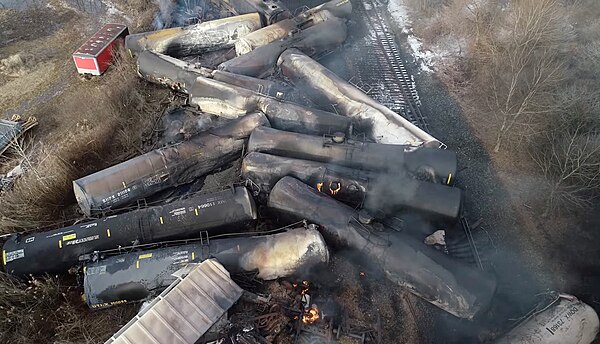
One example of an issue that is taken too casually is the issue of train wrecks, which have occurred year after year. It has recently been highlighted by the train derailment in East Palestine, Ohio on February 3rd, which was a major environmental catastrophe for nearby communities. Toxic chemicals contaminated the area, and the local residents were sick. Even many researchers who came to East Palestine to check the air and water got sick; this includes members of research teams from Purdue University and from the federal CDC (Centers for Disease Control and Prevention). Politicians and the EPA say the air and drinking water are safe, but people keep getting sick anyway. (2) This was an issue where mass anger spread among people who otherwise might not have been thinking about these things.
But for the major national environmental groups, it was just an occasion for business as usual — just a few statements for the press. They didn’t organize widespread actions or campaigns on the issue. They didn’t stress that the regulatory agencies will be nothing but fronts for industry so long as they rely on self-regulation and self-reporting by the train companies and other corporations. Nor did they seek to connect the issue of ensuring train safety with the struggle of railroad workers, even though the situation was volatile due to the suppression of the workers’ contract demands that had recently occurred. In this case, the issue of worker safety was directly linked with the safety of communities near railroad lines, but the establishment environmentalists didn’t pay much attention. (3)
This nonchalence about what’s happening on the railroads isn’t due to train derailments being rare. On the contrary, train derailments take place all the time; it’s just that they aren’t reported very often. On the average more than three freight trains a day derail! Not all the derailments are major events; many just take place in switching yards, although these still endanger railroad workers; but with 12,400 derailments over the last decade, the sheer volume of accidents shows this is a major issue. The Department of Transportation reports that the railroads have admitted that about 6,600 of the derailed cars in this period carried hazardous materials, and 384 cars released these poisons and toxins. (4) This is presumably based on railroad self-reporting, so it is probably an undercount, but still this suggests that may be several major hazardous leaks every month.
If passenger trains derailed at the rate of freight trains, no one would ride them. Freight trains could be made safer. And a large increase in the use of trains instead of trucks would be useful in cutting carbon emissions, which is another reason this should have been an important issue for serious environmentalism.
But what happens is that trains derail one after another, while railroad capitalists drag their feet on well-known safety measures. It’s not because the companies are going broke; indeed they make larger and larger profits each year. But they are cutting the workforce, including those workers who are supposed to be inspecting trains, thus making a sham of safety regulations. The size of train crews has also been cut, making it harder for them to deal with emergencies and avoid derailments, and endangering their safety.
Moreover, the derailments are connected to the overall way that the major government environmental agencies are presently acting. The regulatory agencies are run on the basis of the system of self-reporting. With regard to railroads, this means that the agencies get their information from the railroad companies, rather than having their own independent inspections that can check up on what the railroad capitalists are really doing. And, as shown in East Palestine, agencies like the EPA currently serve as accomplices to the railroads, telling people not to worry—they supposedly aren’t really getting sick from the release of industrial pollutants--rather than keeping strict track of the damage done by unsafe railroad practices and penalizing the guilty railroad bosses. None of the proposed legislative and regulatory changes would end this system of self-reporting. (5) Exposing and campaigning against what’s happening on the railroads would thus help highlight an issue that needs to be stressed all the time in dealing with all the major polluters.
True, there has been a number of militant actions by activist groups that have sought to block particular stretches of rail lines in order to stop oil and hazardous shipments, or as part of a campaign to block some polluting project. These are important, but they have been local actions for which the railroads are just a subsidiary issue. They have not been part of a a general campaign about the situation of the railroads or in solidarity with railroad workers.
Yet such a campaign would be a way for the environmental movement to appeal to the mass of railroad workers. There is lots of talk about how to bring workers into environmental coalitions, but this will not amount to much unless the environmental movement connects closely to struggles of the working class. Railroads are only one example of the environmental issues that arise all the time directly concerning the working class. Dealing with such issues would not be an easy thing to do, because the American trade unions are largely led by a class-collaborationist leadership, while the establishment section of the environmentalists is concerned with making deals with the corporate leaderships. It would take sustained effort over a period of time for a specifically working class section of the environmental movement to develop. But failure to work effectively towards this aim is one part of the present crisis of the environmental movement.
(1) Lyric Aquino, “2022 Was a Particularly Deadly Year for Land and Environmental Activists”/Nearly a quarter of those killed were indigenous", April 17, 2023. Also see Patrick Greenfield, “More than 1,700 environmental activists murdered in the past decade--report//Figures likely to be an underestimate, says Global Witness, as land defenders are killed by hitmen, crime groups and governments", September 28, 2022, The Guardian.
(2) Urja Sinha, “Researchers in East Palestine got sick after testing air, water”, News Nation, April 8, 2023/
(3) One partial exception is that a local branch of the Sierra Club, not the national organization, has organized the “La Coalition’s Rail Safety Campaign”, which is “an official campaign of the Woods & Wetlands Group, Sierra Club - IL”, and it “engages legislators, emergency responders, and administrators at schools and other public facilities located near rail corridors where toxic and explosive substances are transported or stored.” (https://la-coalition.org/about) It doesn’t seem to deal with the rail workers, though. But the establishment groups mostly just issued a few statement statements in favor of the milquetoast Railway Safety Act of 2023 which was proposed in the US Senate.
(4) Sanya Mansoor, “As Norfolk Southern Faces NTSB Investigation, Train Derailments Are More Common Than You Might Think”, Time, March 8, 2023.
(5) At most, the Railway Safety Act of 2023, if passed in its present form, would call for some input from workers, as simply one of many interested parties. <>
Picture: The train derailment at East Palestine, Ohio. <>
Back to main
page,
how to order CV,
write us!